For those of you (assuming I actually have readers) who know my character Lorenzo Vincenzi, I'm returning to him. He's going through some transitions. First of all, I'm holding off on the first storyarch in order to jump deeper into his life. For this reason, characters and places get a little different mention--and minimal introduction--in this treatment. Second, I'm trying to incorporate a more "found document" style of writing. The style is premised on finding a jumble of documents and trying to put them together. I'm ditching some of Vincenzi's experience in order to just make him speak for himself rather than through exposition.
So here it is. Ideally, the "clippings" pieces would be formatted differently, spaced further down the page, and even appear scanned or copied through an old Xerox machine with gray background and black text. Not all the dates will be clear for stylistic reasons ("Lo" is increasingly lost in his own sense of time and place) but postmarks, clippings, and other markings at the beginning of a section should "remind" readers where different pieces fit together.
For those who have no idea what this is about, Vincenzi is a detective of sorts. He is enmeshed in a world drawn from weird fiction and, to a lesser extent, horror and SF. Vincenzi is uncertain of the extent to which that is the case. For those aware of the work of HPL, then some names and places will ring familiar. That said, it should not be essential to know and enjoy this work if I do it well.
...
Community News, April 4
The Church of the New Life opened its doors Monday in the Delta Plaza shopping center. Sister Veronica Gardner, or Ronnie as she prefers, describes the Church's mission as "ecumenical and nondenominational" and "welcome to all the community." Ms. Gardner invites the entire community to visit and meet with her fellow congregants. Services are held daily at 7:00 am and 9:30 am, though morning prayer begins at dawn to "welcome each beautiful day," according to Ms Gardner. Congregants are encouraged to take part and even lead services once they are familiar. The adjacent suites, formerly a Subway and Curves Weight Loss Center, remain vacant but their "For Lease" signs have been removed.
Journal
April 22
I manage to forget far more than I remember. For example, I have forgotten why it was a good idea to trap myself in a walk in fridge. If only I were lucky enough to forget why I was interested in this fishy smelling strip mall in the first place. Toni had to throw that duffel on my table like we were old friends, going all the way back to the good ole days or something. She could have been nicer about handing me my own detonator.
So here I am, waiting for my pen to die or hypothermia to shutdown my fingertips and it is all I can do to not break down that damn steel door taunting me with its facelessness because that horrible scrabbling in the walls sounds like some army of rats waiting for loathsome release. Underneath or behind or somehow nestled in it are enough human words that I suspect someone is outside that faceless steel door, but they might as well be coming from the rats or whatever the hell that is while the refrigerator hums mercilessly, shuffling everything into a deck of malice and misfortune. Then there is the smell of brine and squid and bad fish getting into my coat and nostrils and--God help me--underneath my lids. I find myself scratching at my wrists and stomach so I picked up the pen.
It isn't helping. Well, not much anyway.
Okay, it is helping. I stopped there and wanted to wrap myself up in cardboard and through semi-frozen tilapia against the wall to hear something besides the rats and the hum and the muffled voices, so it is probably better that I stick to writing. All I can think of is how I got here so I guess that's all I have to write.
Things haven't been going well. That's no surprise coming from someone writing in his notepad from a fridge he's worried he's going to take the big sleep in. And then there is the third person coming up, so yeah, definitely more on the worst of times than the best of times.
I've been combing personals in the free papers and Sabine's been printing out more from online. Plenty of calls from and waiting by the payphone nestled in the dingy corner at the Bean. I bet you didn't think there was still a payphone working, but not everyone is so luck to be fiddling with a gewgaw. I rely on paper. Silicon doesn't play nice with me. That's that. When I'm not here, I'm sleeping under a mattress held aloft by books across the street. It isn't falling apart and roaches don't scramble the floor, but it doesn't exactly have the heart that makes it a home. Well, maybe it is underneath the neighbor's floorboards, but I haven't checked.
Speaking of neighbors, I've given up on the crumpled piles of numbers on the floor hours ago and am nursing a headache of hunger and caffeine and eye strain, when Toni Wilcox strolls in and throws a bag full of lead pipes on the table. That's what it sounds like, anyway.
I moan and refuse to look up, though I can tell its her from the smell of India ink.
"Need work?" She asks. My ears perk and my eyes move at a Thomas the Tank Engine pace; slow and steady and like veins full of lactic acid. "Figure out where this came from."
Just as my eyes are about to meet her's, a scrappy hardbound notebook slides into view. My hands are moving and my eyes are trying to catch up, my last coffee suddenly kicking in. The pages are marked with heavy handed lines that carve into the notebook, leaving valleys in subsequent pages. It has a heady smell like papyrus, like something sturdy that has decayed. Despite the weight of the scribe, the words and symbols are elegant and neat, each letter has been marked several times as if the author needed to cement them to the page.
There is Latin, Greek, Arabic, German. I can't make sense of most it. Many are similar but seem to be archaic spellings, extra letters and flourishes that demand further attention to discern. I consider that with a meal and some rest I made be able to translate some of it. My Arabic is rusty, but any tool needs oiling now and then. I can pick out German, but there are names for people and places and long, winding sentences that challenge my grammatical construction. I think back to Hans and I reading Kant and him remarking on the ease of it compared to the German; it was all I could do to not tear the pages out one by one.
The words didn't always make sense when I could put them together. I wondered if it was coded when I read "dreaming death" in Latin and "ineffable names" in Portuguese; but coming upon "pages of flesh" in German I knew that it wasn't. Whatever was written here was as plain as day for the person, or persons capable of reading it.
I was flipping into the middle of the book when I heard Toni's making a shuffling noise.
"Go on," she said as I looked up at her. She casually fanned a stack of bills, twenties by the look of them. I don't know how much comes in a stack of bills, but it looked like enough to make a deck of cards out of and that meant one grand at least. The duffel was unzipped just enough so I could see it was filled with bound bricks of cash. My eyes jumped from the duffel, to Toni still running her right thumb over the stack in her left hand, and then to the book. Toni was not smiling. I flipped the next page of the book.
The page and the next one, and the one after that and after that seemed to describe chaotic but mathematical motion, like the trails of subatomic particles that show up in Discover and Scientific American. They suggested space and size that was both immense and minuscule. Small, tight letters captioned the images, though it was not in anything I recognized.
Going deeper, the charts were abandoned for architectural designs, annotated with numbers suggesting incredible proportions. A pyramid like a ziggurat was raised as high as a mountain, stooped as they were in the background. Jagged towers suggested impossible angles and heights. A whole city seemed inscribed with cuneiform or some similar early script.
I was turning one more page when Toni's hand came out and covered mine.
"Save that for later." She said sternly and removed her hand. She had replaced her book into her duffel, though change sat at the table with two cups of coffee and a three hefty looking pastries with speckled poppy sseds. I knew from better days they were filled with leek, lamb, cheese, and spices; a favorite of Sabine's, and of mine. Toni pushed the plate next to me, a fork and knife balancing on the rim.
I gingerly raised the fork, looked at Toni, then set it down and picked up one of the pastries. I bit into the flaky crust and smelled the spiced lamb underneath, my teeth collided with a hefty potato, and my tongue burned at the heat. It was gone in a moment and I ate the next just somewhat more slowly. The first two sat like billiard balls in my stomach. I straightened up, picked up the fork in left hand and the knife in my right and neatly nibbled on the last pastry.
"What's the job?"
"Finding out where this came from," she slid the now closed notebook close to the duffel bag.
"You don't know?"
"That's the job."
I swallow the last of my pastry. As it joins its comrades, I reflect on how glad I am that I ate before saying, "Well, let's get started."
Wednesday, July 17, 2013


Tuesday, July 9, 2013
Poems from June III - Haiku
I tried to avoid haiku during June. It is a style I am fairly familiar with and therefore wanted to stay away from. In addition, writing such short pieces felt disingenuous to the exercise despite how I enjoy them. That said, I returned to the concept of nothingness and wrote a series of haiku dealing with it.
"Six Empty Haiku and One on Fire," June 30, 2013
A Cat & i walk,
finding emptiness crumpled
in packs of twenty.
Two bottles: blessings
of gratitude, made full by
joyful emptiness.
An almost vacant
room made full & warm with
music, wine, comrades.
Empty pages that are
marble waiting for hammer,
chisel, & patience.
The hollow of an
empty glass; a nothing that
marks meaningfulness
This space stands littered
with the trails of those not now
present passers-by.
Fire of a forge
held aloft between fingers
sculpting brilliant words.
...
Reflections: All in all, I wrote 15 poems in 30 days. Not exactly hitting the mark, but a solid exercise. The regularity of haiku I've practiced in the past probably maintained the perspective I was trying for more than this. That said, poetic writing is a challenge and this was a nice way to get in the habit. In addition, I need to finish an essay I started last month on SF and alien encounters that allows me to meditate on what a first contact scenario might actually resemble. (Now I'm pondering a follow up that pits this more in the, "They're already here" scenario and why that would be viable.) I think I'll get to that later on today.
In the quotidian, I am cleaning and seasoning my cast iron. It is an exercise in patience and attention that I very much enjoy. Here's a little poem about it:
Iron recast by
loving heat, purifying
with patient practice.
There is something about fire/heat/energy and emptiness/vacancy/nothingness that I find perfect themes in poetry. They envelop whole fields of imagery, personal experience, transformation, functionality... I just love it. Perhaps I am already becoming too reliant on them.
Also in the day-to-day, I'm considering a condo or home purchase, even to the effect of taking a first-time homebuyers' class at BOTHANDS on August 17th. Anyone want to join?
"Six Empty Haiku and One on Fire," June 30, 2013
A Cat & i walk,
finding emptiness crumpled
in packs of twenty.
Two bottles: blessings
of gratitude, made full by
joyful emptiness.
An almost vacant
room made full & warm with
music, wine, comrades.
Empty pages that are
marble waiting for hammer,
chisel, & patience.
The hollow of an
empty glass; a nothing that
marks meaningfulness
This space stands littered
with the trails of those not now
present passers-by.
Fire of a forge
held aloft between fingers
sculpting brilliant words.
...
Reflections: All in all, I wrote 15 poems in 30 days. Not exactly hitting the mark, but a solid exercise. The regularity of haiku I've practiced in the past probably maintained the perspective I was trying for more than this. That said, poetic writing is a challenge and this was a nice way to get in the habit. In addition, I need to finish an essay I started last month on SF and alien encounters that allows me to meditate on what a first contact scenario might actually resemble. (Now I'm pondering a follow up that pits this more in the, "They're already here" scenario and why that would be viable.) I think I'll get to that later on today.
In the quotidian, I am cleaning and seasoning my cast iron. It is an exercise in patience and attention that I very much enjoy. Here's a little poem about it:
Iron recast by
loving heat, purifying
with patient practice.
There is something about fire/heat/energy and emptiness/vacancy/nothingness that I find perfect themes in poetry. They envelop whole fields of imagery, personal experience, transformation, functionality... I just love it. Perhaps I am already becoming too reliant on them.
Also in the day-to-day, I'm considering a condo or home purchase, even to the effect of taking a first-time homebuyers' class at BOTHANDS on August 17th. Anyone want to join?
Poems from June II
I'm not especially happy with these. They employ themes that I generally find uninteresting in others' poetry. That said, I was able to fiddle with my own comfort and interest in the imagery.
Rogue Planet, June 11, 2013
I find myself adrift in achorless space,
a planet shot away from its stellar center,
from its satellites and neighbors,
from those astronomic coordinates,
from the astrological gods that are
always eager to guide my way.
...
I find myself in parts unkown
where every star & quasar & gaseous giant--
with their own myriad moons--
with their draw of light,
with their draw of gravity,
with their own draw of a new pattern
of stars & gods & neighbors.
...
I find myself amongst alien vistas
of brilliant ultraviolet dawns,
of occultations of super-earths,
of roiling hot ice seas that
crackle with plasmic life
& parallel intelligences
seeing their world & my passing
with bizarre serenity
passing by on weird, spherical music.
Skin Stories, June 16, 2013
She has scars
& she tells me about them
but they are not the stories
the stores that cause the
softly expanding blemishes
beauty marks that are
unbeautiful.
Graffiti, June 2013 (specific date unknown)
A tapestry of asphalt & concrete,
a palimpsest of insults & artistry.
What might have been said?
What might be read?
What secret languages
have been spoken and forgotten?
What loves have been
transcribed, affirmed,
& now destroyed
by a stewardly brush?
Rogue Planet, June 11, 2013
I find myself adrift in achorless space,
a planet shot away from its stellar center,
from its satellites and neighbors,
from those astronomic coordinates,
from the astrological gods that are
always eager to guide my way.
...
I find myself in parts unkown
where every star & quasar & gaseous giant--
with their own myriad moons--
with their draw of light,
with their draw of gravity,
with their own draw of a new pattern
of stars & gods & neighbors.
...
I find myself amongst alien vistas
of brilliant ultraviolet dawns,
of occultations of super-earths,
of roiling hot ice seas that
crackle with plasmic life
& parallel intelligences
seeing their world & my passing
with bizarre serenity
passing by on weird, spherical music.
Skin Stories, June 16, 2013
She has scars
& she tells me about them
but they are not the stories
the stores that cause the
softly expanding blemishes
beauty marks that are
unbeautiful.
Graffiti, June 2013 (specific date unknown)
A tapestry of asphalt & concrete,
a palimpsest of insults & artistry.
What might have been said?
What might be read?
What secret languages
have been spoken and forgotten?
What loves have been
transcribed, affirmed,
& now destroyed
by a stewardly brush?
Poems from June I
Iron Song, June 8, 2013
Iron veins sing
the oncoming rushing
the roiling steel
& are thankful
thankful for its approach
for its presence
for its departure
& sing for its passing.
Bricks, June 16, 2013
(My Habitat for Humanity poem; this was previously posted on my Facebook page.)
I have bricks for hands & mortar for words
& I am pounding with hammer fingers, hammer eyes;
I have a screwdriver tongue & paintbrush hair
& my ears are plugs into my power grid brain.
I lose my wooden legs to shingle the house,
& each toe forms a gently opening door.
My thoughts conform to beds & countertops & scattered silverware.
My hot, thrumming heart is an oven, the aorta reaching outward
& within is a loaf of bread, light but hearty & sustaining...
I am waiting for it to be ready.
No Mic, June 18, 2013
The human voice is the finest
--& maybe the most coarse--
of all--& of any--instrument.
Which is why I do not
--or maybe it is that I cannot--
use the microphone in front of
--or maybe behind--me.
The human voice can deliver
a moan--or a groan--,
a soliloquy--or a sermon--,
an exhaltation--or a damnation--
& in so intoning--or keeping silence--
that peculiar--& particular--human noise.
Spokes, June 18, 2013
Spokes hold the wheel.
The wheel holds the spokes.
The hub holds the center.
I whir & whir & whir,
spinning around some middle,
some unknowable gravity well.
Wheels carry me to & from,
each made of nothingness
& movement & spokes.
[Note: This meditation on nothingness is picked up again in the haiku I wrote on the 30th.]
Iron veins sing
the oncoming rushing
the roiling steel
& are thankful
thankful for its approach
for its presence
for its departure
& sing for its passing.
Bricks, June 16, 2013
(My Habitat for Humanity poem; this was previously posted on my Facebook page.)
I have bricks for hands & mortar for words
& I am pounding with hammer fingers, hammer eyes;
I have a screwdriver tongue & paintbrush hair
& my ears are plugs into my power grid brain.
I lose my wooden legs to shingle the house,
& each toe forms a gently opening door.
My thoughts conform to beds & countertops & scattered silverware.
My hot, thrumming heart is an oven, the aorta reaching outward
& within is a loaf of bread, light but hearty & sustaining...
I am waiting for it to be ready.
No Mic, June 18, 2013
The human voice is the finest
--& maybe the most coarse--
of all--& of any--instrument.
Which is why I do not
--or maybe it is that I cannot--
use the microphone in front of
--or maybe behind--me.
The human voice can deliver
a moan--or a groan--,
a soliloquy--or a sermon--,
an exhaltation--or a damnation--
& in so intoning--or keeping silence--
that peculiar--& particular--human noise.
Spokes, June 18, 2013
Spokes hold the wheel.
The wheel holds the spokes.
The hub holds the center.
I whir & whir & whir,
spinning around some middle,
some unknowable gravity well.
Wheels carry me to & from,
each made of nothingness
& movement & spokes.
[Note: This meditation on nothingness is picked up again in the haiku I wrote on the 30th.]
Monday, June 3, 2013
30 Poems in 30 Days
First of all, I'm already behind. This is going for the month of June. I have two poems, one written last night about the night before, and one written just now. These are all drafts and have not been adequately revised--well, maybe Bloodletting has--to meet my own expectations. The other thing is that I am out of practice. Most of my poems that I have written over the past, oh, five years have been spur of the moment responses to some blessing or insight or funny phrase. Poetry as a craft demands a practice and a vision, each informing the other, on the world. Perhaps I'll write on that.
In other news, I have a job with Habitat for Humanity (just because it has "volunteer" in the title doesn't mean I don't get paid), Dreux has left to parts unknown (Montana, actually, but only until one of her prospects comes through), and am done with school. I'm done with the post-thesis/new job honeymoon and need to maintain discipline on my writing, my work, my goals, and keeping up with local issues. Hopefully, I can translate some of that into intelligible--and maybe enjoyable--writing up here.
So here are two poems:
Bloodletting (June 2, 2013)
My nose bleeds, as it does up here on the verge of space
in the spacecraft of my body madly tumbling through a void pockmarked by surreal objects.
Each drop recalls a beer, a cigarette, the car exhaust inhaled on my commute,
or the thin air & pine pollen that coats everything;
or the other innumerable, infinitesimal toxins and blessings crashing through my intravenous rapids.
I bleed onto my green-striped white shirt--
which I will frantically wash in the men's room--
and each drop carries those toxins in abundance
like some balancing of humors, an incantation scrawled in blood on a bathroom sink & paper towels
& forgotten sigils inscribed on my upper lip.
My lightheadedness confirms a divine acceptance of my sacrifice to Hermes
whose winged sandals I have worn for these past months--
each day a landscape blinked past on I-17--
& now try to return with fearful gratitude.
The bleeding halts, but never heals,
& I understand the exchange, the mending, the sorcery;
I return--suddenly--from those inhuman speeds.
...
Tarot, June 3 (June 3, 2013)
A star shines
not in the distance
but in the future,
& a man speaks to a judge
on a vague horizon.
The judge holds a scale
that balances a lonely man & a king:
they are the same man.
A queen holds a flower--
here, or maybe now--
& explains peace, oppression, prudence;
while another man walks
between a beautiful woman
and her wide-pawed cat.
...
Post-script: I don't especially like "Tarot, June 3," but wanted to try something out. I have fiddled with Tarot (I have a Thoth Deck and am most acquainted with the Thoth spread) for about a year now. Mostly, my readings are my own and provide some reflection. A reading highlights--to me--particular influences in my life and allows me to single them out. The Tarot is a symbolic representation of the universe and therefore all elements of my life are present in the deck; a single spread addresses just some particularly significant elements of my present, my choices, and my influences. The Thoth spread, as employed and adapted by Crowley, has some unfamiliar characteristics to more common or popularized spreads (usually the three-card spread representing past, present, and future) by articulating present state, possible directions, current influences, and a "destined" or "karmic" influence. Crowley himself used it as a form of meditation. The fantastic artwork was painted by Lady Frieda Harris, though designed by Crowley. Here are some examples (including inspirations from this spread):


Finding high quality scans of these cards is weirdly hard. I may have to amend this situation.
In other news, I have a job with Habitat for Humanity (just because it has "volunteer" in the title doesn't mean I don't get paid), Dreux has left to parts unknown (Montana, actually, but only until one of her prospects comes through), and am done with school. I'm done with the post-thesis/new job honeymoon and need to maintain discipline on my writing, my work, my goals, and keeping up with local issues. Hopefully, I can translate some of that into intelligible--and maybe enjoyable--writing up here.
So here are two poems:
Bloodletting (June 2, 2013)
My nose bleeds, as it does up here on the verge of space
in the spacecraft of my body madly tumbling through a void pockmarked by surreal objects.
Each drop recalls a beer, a cigarette, the car exhaust inhaled on my commute,
or the thin air & pine pollen that coats everything;
or the other innumerable, infinitesimal toxins and blessings crashing through my intravenous rapids.
I bleed onto my green-striped white shirt--
which I will frantically wash in the men's room--
and each drop carries those toxins in abundance
like some balancing of humors, an incantation scrawled in blood on a bathroom sink & paper towels
& forgotten sigils inscribed on my upper lip.
My lightheadedness confirms a divine acceptance of my sacrifice to Hermes
whose winged sandals I have worn for these past months--
each day a landscape blinked past on I-17--
& now try to return with fearful gratitude.
The bleeding halts, but never heals,
& I understand the exchange, the mending, the sorcery;
I return--suddenly--from those inhuman speeds.
...
Tarot, June 3 (June 3, 2013)
A star shines
not in the distance
but in the future,
& a man speaks to a judge
on a vague horizon.
The judge holds a scale
that balances a lonely man & a king:
they are the same man.
A queen holds a flower--
here, or maybe now--
& explains peace, oppression, prudence;
while another man walks
between a beautiful woman
and her wide-pawed cat.
...
Post-script: I don't especially like "Tarot, June 3," but wanted to try something out. I have fiddled with Tarot (I have a Thoth Deck and am most acquainted with the Thoth spread) for about a year now. Mostly, my readings are my own and provide some reflection. A reading highlights--to me--particular influences in my life and allows me to single them out. The Tarot is a symbolic representation of the universe and therefore all elements of my life are present in the deck; a single spread addresses just some particularly significant elements of my present, my choices, and my influences. The Thoth spread, as employed and adapted by Crowley, has some unfamiliar characteristics to more common or popularized spreads (usually the three-card spread representing past, present, and future) by articulating present state, possible directions, current influences, and a "destined" or "karmic" influence. Crowley himself used it as a form of meditation. The fantastic artwork was painted by Lady Frieda Harris, though designed by Crowley. Here are some examples (including inspirations from this spread):


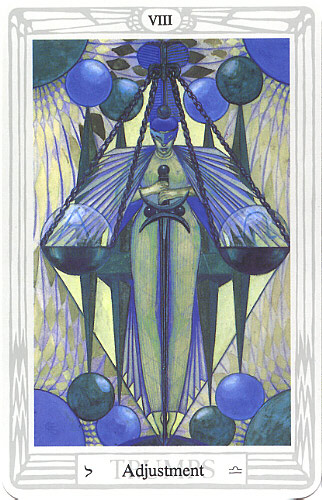

Finding high quality scans of these cards is weirdly hard. I may have to amend this situation.
Sunday, February 17, 2013
Poem: Keys
For Dreux.
...
You said a word that was a key
& the key found a scar,
& the scar touched a nerve,
& the nerve led to a memory,
& the memory was a night,
& the night was a crossroad,
& the crossroad was a dream,
but the dream had no sleeper.
My eyes opened on a wood,
in the wood was a garden,
in the garden was a bench,
on the bench I sat
& she sat with me;
we held each other,
while we fell to piece,
& the piece kept falling
until there was no bench,
until there was no me,
until there was no her.
My eyes opened on a heart-shaped face,
irises flecked with green,
red lips anxiously quivering.
You said a word that was a key,
& the word found a lock,
& the lock was a scar,
& the scar was a nerve,
& the nerve was a memory,
& the memory was a door;
through the memory was a path,
& the path went through me,
& the path was unlit,
but I heard you,
& your words were a light,
& your words were a tether,
& your words were a key.
...
I'm not sure how I feel about this. I have tried to resist sentimentality, to really struggle against it Simultaneously, this does seem to capture the materiality and the empirical experience of this particular moment. I'm reticent to even post this; it might communicate more than I wish to say, but all words are burdened with that potential. Structurally, there is a simplicity that I wanted to work with immediately, a simplicity that carries into rhythm. This might be as close as a I can right now to just a string of nouns attempting to communicate a story (word, memory, door, night, crossroad; wood, garden, bench, her; face, eyes, lips; key, lock, memory, door, path, light, tether, key).
In addition, there are two memories that became (or were revealed to be) intertwined. These women are distinct, but the memories were experienced in an odd unison (a sharedness that irritates for its suggestions about these rather different circumstances). That said, to capture the reality of that immediate experience, I have compressed them just as I experienced them.
...
You said a word that was a key
& the key found a scar,
& the scar touched a nerve,
& the nerve led to a memory,
& the memory was a night,
& the night was a crossroad,
& the crossroad was a dream,
but the dream had no sleeper.
My eyes opened on a wood,
in the wood was a garden,
in the garden was a bench,
on the bench I sat
& she sat with me;
we held each other,
while we fell to piece,
& the piece kept falling
until there was no bench,
until there was no me,
until there was no her.
My eyes opened on a heart-shaped face,
irises flecked with green,
red lips anxiously quivering.
You said a word that was a key,
& the word found a lock,
& the lock was a scar,
& the scar was a nerve,
& the nerve was a memory,
& the memory was a door;
through the memory was a path,
& the path went through me,
& the path was unlit,
but I heard you,
& your words were a light,
& your words were a tether,
& your words were a key.
...
I'm not sure how I feel about this. I have tried to resist sentimentality, to really struggle against it Simultaneously, this does seem to capture the materiality and the empirical experience of this particular moment. I'm reticent to even post this; it might communicate more than I wish to say, but all words are burdened with that potential. Structurally, there is a simplicity that I wanted to work with immediately, a simplicity that carries into rhythm. This might be as close as a I can right now to just a string of nouns attempting to communicate a story (word, memory, door, night, crossroad; wood, garden, bench, her; face, eyes, lips; key, lock, memory, door, path, light, tether, key).
In addition, there are two memories that became (or were revealed to be) intertwined. These women are distinct, but the memories were experienced in an odd unison (a sharedness that irritates for its suggestions about these rather different circumstances). That said, to capture the reality of that immediate experience, I have compressed them just as I experienced them.
Wednesday, January 9, 2013
Body, Image, Photography, Propriety
I have been seeing someone--in a romantic sense that is--for a few months now. She is sharp, playful, genuine, straightforward, and in many ways a complete delight. Only now am I no longer regularly surprised by the clarity of communication, the eagerness for understanding, and the affectionate space constantly expanded to make sense of each other's thoughts and feelings. In addition, she regularly pushes herself to try out the unfamiliar; in the commonplace by tasting unfamiliar food and drink, or by the more anxious such as posing for nude photography.
This, I might add, is what inspires my thoughts and has preoccupied them for a few days.
My immediate response to Dreux being interested was fairly neutral: if she's interested in it, then do it. This isn't surprising in that I pride myself in being supportive of my partners and friends, especially when it is clear that the goal; for Dreux this would be exploring some of the uncomfortable and anxiety-producing space that captivates here. It wouldn't be that different from trying rock climbing out or--if the mood took her and the morality were appropriate--a game hunt. She wants to know what that that world feels like for her, how might it feel for others. This is one reason, or I like to think anyway, that I am so captivated by her and that she is so concerned with high quality communication.
Up until Tuesday morning, this is more or less where I left my thoughts. That morning, Dreux was looking over the photographer's work: a gallery of women, nude and clothed, mostly in wooded settings, occasionally using some fabric or prop to highlight form and light in the image. It was perhaps only then that I realized there would be a photographer actually doing the photographer. I assumed--rightly, as it turned out--that the photographer was a man. The only other person I had considered up until this point was a friend of Dreux's, well-versed in modeling and actually making a career of it. Enough friends and friends of friends have done modeling that I shouldn't have been surprised, but I surprised myself by thinking exclusively of Dreux (with only minor consideration of her friend) as the agent in this photo shoot. The image, so to speak, got a little more interesting on Tuesday.
I admit that questions of trust come to mind. I trust Dreux, and because I do, I also trust the friend who arranged the photo shoot. Neither of them have worked with this photographer, thought that is more a matter of timing than anything. Where the question of trust, or perhaps distrust comes in, is why a photographer would work so explicitly in the female form as a medium for expression. Nudity, human form, the way light works over flesh, the interaction of curvilinear forms and the angular wooded settings, I can understand the richness of such a medium. What happens (or what happened in my mind as Dreux showed me the photographer's work) was the appropriation of these women's image by the photographer. I think Dreux reflected on this as she spoke with the photographer over the phone, realizing that these images of her would not be hers.
This distinction, being of but not owned by that person, is what is most interesting and problematic. There will be release forms and contracts, just as there might be for documenting a campus event for the newspaper in which the photojournalist uses an image to tell the story of the article. What is different--or perhaps elsewhere on the same spectrum--is that the photographer isn't a journalist, he (in this case, though I do not pretend to speak in an exclusive manner) is constructing an image, a piece, a world, an exhibition with these bodies--these women's bodies--who are not his. Rather, through contract and direction, through light on film, chemical baths and dark rooms with glimmering red lights, these women have given him their bodies for use.
I think that Dreux's initial concern when she raised the topic to me--though she has not been explicit in confirming this--is that I would have some sense of proprietary about her participation. I think many partners--I want to default to men, but doubt that it is an exclusively masculine trait--would be unnerved in some way in this situation, musing in some form of, "Your body is something intimately given, intimately shared. To give your image a way is a breach (maybe a challenge of annulment) of that intimacy." This could be thought of as a "sympathetic" explanation of practices that conceal women's bodies from public places. In some ways, I understand Dreux's reasons enough to know that this is not the case; she is exploring out of her own curiosity and pressure on herself to make herself uncomfortable, if it might provide insight or amusement.
Instead--and this is why it took looking at the gallery of other images to come to mind--I wonder about the proprietary attitude of the photographer. Who are these women--and as far as I could tell, these were exclusively women subjects--to the photographer? How does he maintain them as individuals, as subjects while necessarily appropriating their image and objectifying them? And if the question is "capturing" some "character" or "spirit" of the subject (stealing from phrases that come to mind, not any words of the photographer himself), then how is direction to the model defended? Is the model preserved as anything more than just a pretty suite of forms and light, a pleasant play of light?
Let me point out two things here: First, I have transitioned from referring to Dreux directly, to referring to "the subject" and "the model." This was unintentional, though not unsurprising given my analysis and the fact that the shoot is today. I clearly have some tension arising from questions--to me, significant ethical questions concerning photography and modeling--that I cannot here answer. I can put some distance between myself and my inability to know. Second, I have--and somewhat intentionally--assumed an unsympathetic if not hostile posture towards this photographer in particular and modeling in general. I recognize this, but have hoped to provide a transition from the photographer as a passive or entirely absent agent--in my early thoughts on the subject--to the arbiter of the entire situation. I am not exactly there, but have displayed some range of how the photographer might be perceived. Dreux, I am sure given the phone discussion and her own attention to self, will not allow herself to be pushed to perform outside of what she finds appropriate. (Phrasing that clunky sentence is difficult, as this is clearly stretching her comfort zone. Does this contextualization itself allow/encourage giving up more agency or less?)
What I'm left with are questions I still cannot answer. What I can do is project various identities onto the most unknown figure: the photographer. Rather than accept not knowing, or waiting to hear some explanations/defenses, I can project various images of my own onto him. The photographer develops--without further insights and information--into a reservoir for all the voyeuristic and coercive masculine traits that I want to disown and challenge.
I am sure that there are more concise and critical explorations of modeling, informed by feminist theory and the rest, but I have been playing with these ideas for a few days and wanted to get them down. In addition, I owe it to Dreux to give space to explain what has been in my head, as this could not easily be unpacked in a strictly conversational space. Given a "passive" photographer, I have little concern about Dreux's participation in modeling. Such a photographer doesn't exist; instead, I have an agent positioned in what feels like an ethically problematic space. Ethically problematic not because of propriety of a partner--who wants to preserve the intimacy shared between them and what feels pretty much juvenile--but because of the propriety of the photographer taking a person and sublimating the body into an image (or series of images).
Have I come upon any unexpected answers? Not really. But at least I have something to share with Dreux.
---
Note: This probably needs some editing, which I may do in the next few days or entirely postpone. This is just a blog after all.
This, I might add, is what inspires my thoughts and has preoccupied them for a few days.
My immediate response to Dreux being interested was fairly neutral: if she's interested in it, then do it. This isn't surprising in that I pride myself in being supportive of my partners and friends, especially when it is clear that the goal; for Dreux this would be exploring some of the uncomfortable and anxiety-producing space that captivates here. It wouldn't be that different from trying rock climbing out or--if the mood took her and the morality were appropriate--a game hunt. She wants to know what that that world feels like for her, how might it feel for others. This is one reason, or I like to think anyway, that I am so captivated by her and that she is so concerned with high quality communication.
Up until Tuesday morning, this is more or less where I left my thoughts. That morning, Dreux was looking over the photographer's work: a gallery of women, nude and clothed, mostly in wooded settings, occasionally using some fabric or prop to highlight form and light in the image. It was perhaps only then that I realized there would be a photographer actually doing the photographer. I assumed--rightly, as it turned out--that the photographer was a man. The only other person I had considered up until this point was a friend of Dreux's, well-versed in modeling and actually making a career of it. Enough friends and friends of friends have done modeling that I shouldn't have been surprised, but I surprised myself by thinking exclusively of Dreux (with only minor consideration of her friend) as the agent in this photo shoot. The image, so to speak, got a little more interesting on Tuesday.
I admit that questions of trust come to mind. I trust Dreux, and because I do, I also trust the friend who arranged the photo shoot. Neither of them have worked with this photographer, thought that is more a matter of timing than anything. Where the question of trust, or perhaps distrust comes in, is why a photographer would work so explicitly in the female form as a medium for expression. Nudity, human form, the way light works over flesh, the interaction of curvilinear forms and the angular wooded settings, I can understand the richness of such a medium. What happens (or what happened in my mind as Dreux showed me the photographer's work) was the appropriation of these women's image by the photographer. I think Dreux reflected on this as she spoke with the photographer over the phone, realizing that these images of her would not be hers.
This distinction, being of but not owned by that person, is what is most interesting and problematic. There will be release forms and contracts, just as there might be for documenting a campus event for the newspaper in which the photojournalist uses an image to tell the story of the article. What is different--or perhaps elsewhere on the same spectrum--is that the photographer isn't a journalist, he (in this case, though I do not pretend to speak in an exclusive manner) is constructing an image, a piece, a world, an exhibition with these bodies--these women's bodies--who are not his. Rather, through contract and direction, through light on film, chemical baths and dark rooms with glimmering red lights, these women have given him their bodies for use.
I think that Dreux's initial concern when she raised the topic to me--though she has not been explicit in confirming this--is that I would have some sense of proprietary about her participation. I think many partners--I want to default to men, but doubt that it is an exclusively masculine trait--would be unnerved in some way in this situation, musing in some form of, "Your body is something intimately given, intimately shared. To give your image a way is a breach (maybe a challenge of annulment) of that intimacy." This could be thought of as a "sympathetic" explanation of practices that conceal women's bodies from public places. In some ways, I understand Dreux's reasons enough to know that this is not the case; she is exploring out of her own curiosity and pressure on herself to make herself uncomfortable, if it might provide insight or amusement.
Instead--and this is why it took looking at the gallery of other images to come to mind--I wonder about the proprietary attitude of the photographer. Who are these women--and as far as I could tell, these were exclusively women subjects--to the photographer? How does he maintain them as individuals, as subjects while necessarily appropriating their image and objectifying them? And if the question is "capturing" some "character" or "spirit" of the subject (stealing from phrases that come to mind, not any words of the photographer himself), then how is direction to the model defended? Is the model preserved as anything more than just a pretty suite of forms and light, a pleasant play of light?
Let me point out two things here: First, I have transitioned from referring to Dreux directly, to referring to "the subject" and "the model." This was unintentional, though not unsurprising given my analysis and the fact that the shoot is today. I clearly have some tension arising from questions--to me, significant ethical questions concerning photography and modeling--that I cannot here answer. I can put some distance between myself and my inability to know. Second, I have--and somewhat intentionally--assumed an unsympathetic if not hostile posture towards this photographer in particular and modeling in general. I recognize this, but have hoped to provide a transition from the photographer as a passive or entirely absent agent--in my early thoughts on the subject--to the arbiter of the entire situation. I am not exactly there, but have displayed some range of how the photographer might be perceived. Dreux, I am sure given the phone discussion and her own attention to self, will not allow herself to be pushed to perform outside of what she finds appropriate. (Phrasing that clunky sentence is difficult, as this is clearly stretching her comfort zone. Does this contextualization itself allow/encourage giving up more agency or less?)
What I'm left with are questions I still cannot answer. What I can do is project various identities onto the most unknown figure: the photographer. Rather than accept not knowing, or waiting to hear some explanations/defenses, I can project various images of my own onto him. The photographer develops--without further insights and information--into a reservoir for all the voyeuristic and coercive masculine traits that I want to disown and challenge.
I am sure that there are more concise and critical explorations of modeling, informed by feminist theory and the rest, but I have been playing with these ideas for a few days and wanted to get them down. In addition, I owe it to Dreux to give space to explain what has been in my head, as this could not easily be unpacked in a strictly conversational space. Given a "passive" photographer, I have little concern about Dreux's participation in modeling. Such a photographer doesn't exist; instead, I have an agent positioned in what feels like an ethically problematic space. Ethically problematic not because of propriety of a partner--who wants to preserve the intimacy shared between them and what feels pretty much juvenile--but because of the propriety of the photographer taking a person and sublimating the body into an image (or series of images).
Have I come upon any unexpected answers? Not really. But at least I have something to share with Dreux.
---
Note: This probably needs some editing, which I may do in the next few days or entirely postpone. This is just a blog after all.
Subscribe to:
Posts (Atom)


